
A new-to-me release.
Many years ago I picked up Romeo Unchained and Notes from the Lost Civilization (not in that order), mainly because they were on WHAT?/A&M, where Mark Heard's iDEoLA project was released. So I figured it was a guilty-by-association sort of thing. It was an indie label after all, so that had to mean something.
I remember liking Notes from the Lost Civilization, but honestly, I was getting so much music back then that unless something really blew my hat off, I gave it a listen or two and then filed it away.
Here I am years later, and up pops a rather water-damaged copy of Life in the Foodchain. It made me sad looking at it. The vinyl was in surprisingly good shape, but any liner notes and credits were long lost to the gods of misplaced socks. Still, this was an album I had always been curious about, so I brought it home, where it joined the queue of treasures waiting for a turn(table).
I popped it on, and the title track was cranked in the cave (everyone was out, so why not?). The big riffs were just starting to hit when I said to myself, "Holy cow." It's at this point I sorely missed the credits and lyric sheet. I also saw, in small print in the bottom left, the date of the release: 1978. Figures.

That was a few days ago, and I'm still playing the album over and over. I am not the most objective listener, and my ability to actually discern whether something is good or not kind of blurs into a soupy fog. Things are enjoyable, or they're not. Of course, I'm always cognizant of high points, since they stand out.
To badly paraphrase a saying paraphrased by J.F.K.: "A great song lifts up the rest of the album." Of course, others will espouse: "One hit, the rest shit!"
Earlier I mentioned the missing liner notes, so it was off to the internet to read the lyrics and get a list of credits. Wow, there were a lot of names I knew. Among them: Dick Dale, Albert Lee, and Earl Slick on guitar, Garth Hudson from The Band lending accordion, and drummer Curly Smith. The album was produced by Rob Fraboni, who was known for his work with Dylan, Eric Clapton, and The Band.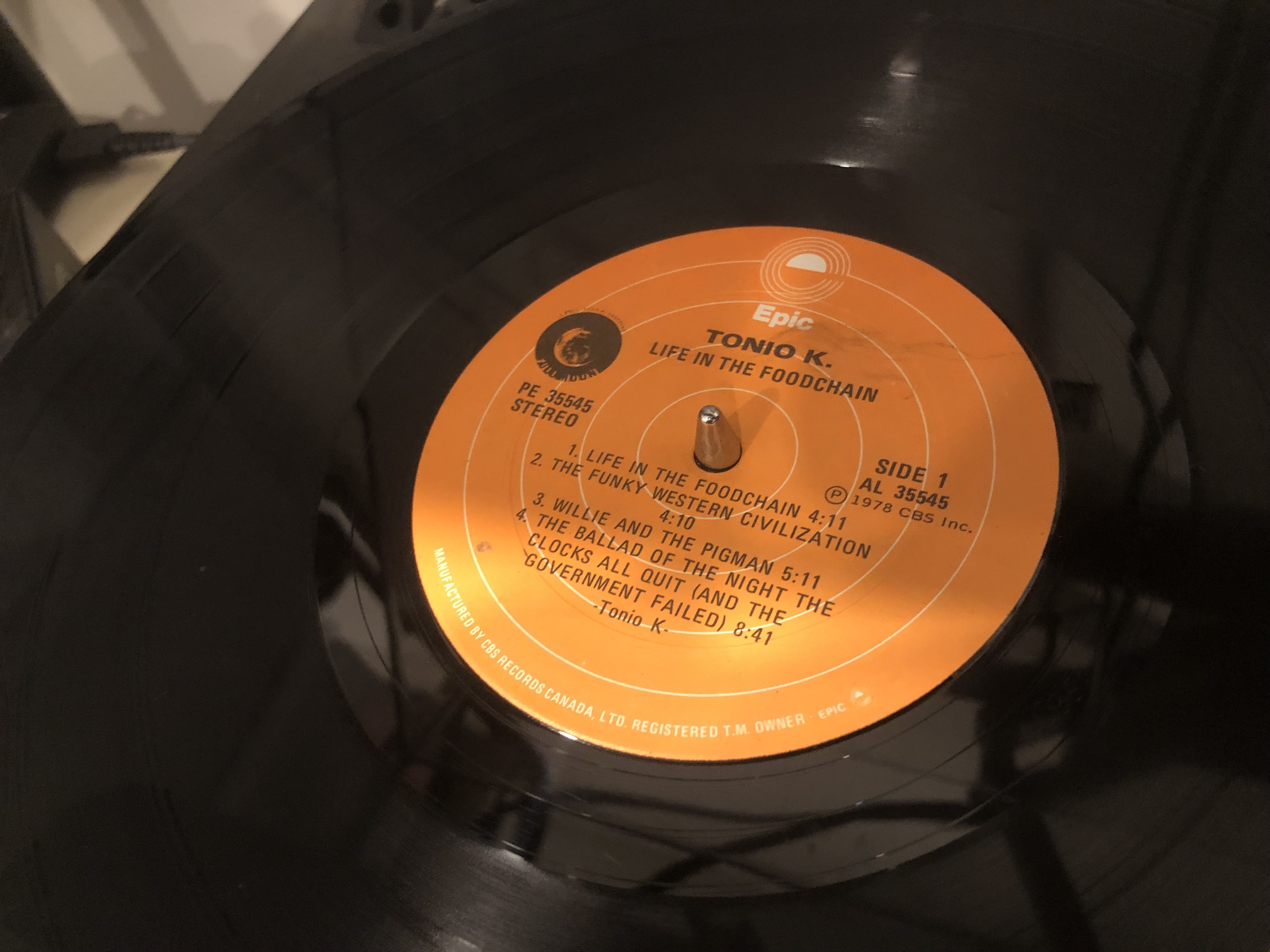
Like Tonio K. writes on the title track:
Kind of like mowing the lawn
Everything gets to this certain dimension
Winds up on a customer's plate and then gone
But it's not gone is it?
Comments
Post a Comment