
Gary Wright - The Dreamweaver

Gary Wright - Dream Weaver

Just about everyone's heard "Dream Weaver" - I suppose Wayne's World can take credit for that (although it is a different version, he did like to re-record this song). Still, when I found this album I was pretty stoked, as I happen to like that song, but I really liked "Love Is Alive" and I'll be honest, I'd forgotten about that one until I dropped the needle. Then it was, "Holy mackerel. I love this song."

While my dollar-bin copy didn't have an insert, there were decent credits on the back cover, and it was cool to see names like David Foster, drummers Andy Newmark and Jim Keltner, and even a guitar cameo by Ronnie Montrose on "Power of Love." It's the only guitar on the album, and it comes at the close of the first side.

After setting the tone with the various keyboards and special effects on the first four songs, I actually didn't even notice the guitar the first time through. Dang, even on the second pass it was there, but just part of what drove the song. I guess it served the song, but seems like a waste of a marquee name.

Gary Wright - Dream Weaver Credits

Gary makes a point of mentioning on the back cover that "this is an album of keyboard music." With the exception of drums and vocals, all the music heard was produced by keyboard instruments. Which is pretty cool, and I'm glad that this was made in 1975 because a few years later no doubt he'd have used drum machines, and removed one of the elements that make this so enjoyable.

The interplay and tension between organic and synthetic.

It also doesn't hurt that Gary has a great voice.

The second side opens with "Dream Weaver." It's been a while since I've sat and listened to this. I'd actually kind of forgotten how cool this song is.

I do like the Moog bass, especially when combined with the acoustic drums. The rhythm section it underpins everything. It's not an understatement to say this reverberated through future popular music and even progressive rock. Heck, SAGA would use Moog bass, and still does.

The spacey ending was no doubt heard by John Hall from Prism, and I suspect influenced "Spaceship Superstar." Makes me wonder if Chris de Burgh heard this before writing "A Spaceman Came Travelling." Considering both were from 1975, but his was later in the same year, it would make for an interesting coincidence, but is unlikely.
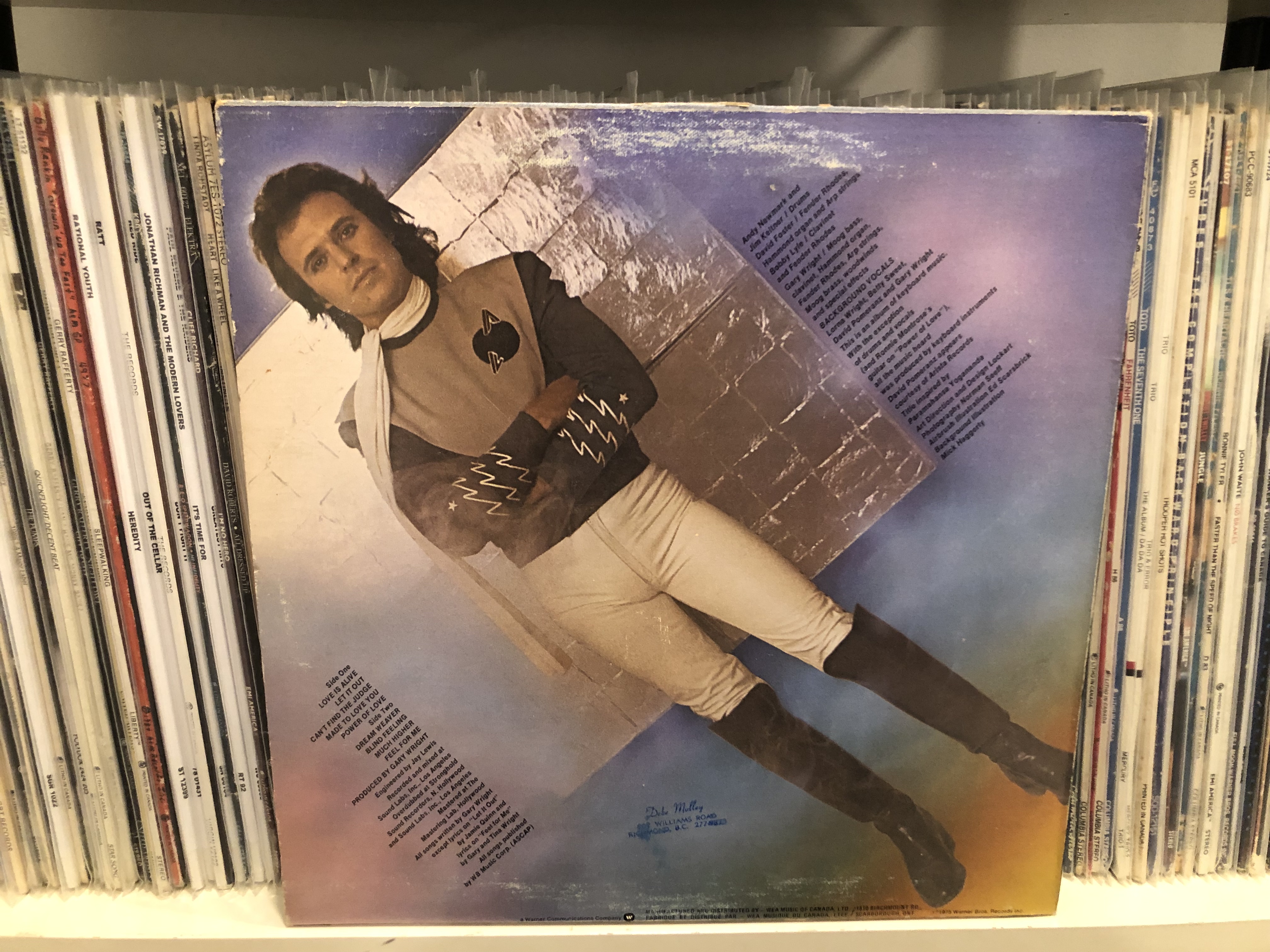
Gary Wright - Dream Weaver back cover

"Much Higher" takes the delayed keyboard riff from "Love Is Alive," slows it down, and marries it to a mid-tempo rock groove. It's a decent callback to the opening track and fits the tone of the album and is enjoyable in the context of the record, but not something that perks my ears up.

The album closes out with a pretty forgettable song, "Feel for Me," that just sort of played in the background.

While this wasn't full of killer songs, two of the nine are so good they lift the entire album. The worst I can say is the other songs are decent but not memorable, and at least they didn't suck.

That would have tanked the album for me - killer songs or not.

Comments

Popular posts from this blog

Styx - Paradise Theater

Styx was hands down one of my favourite bands as a kid. They were a strange band, even back then. They were a hard rock band, almost progressive at times, who had a penchant for sucky ballads. I know there's a tendency for people to zero in on "Babe" as the song that killed the band's credibility. The roots go way back to almost the beginning when Styx released "Lady" on their second album. It showed a side to the band that needed to be kept in check, and for the most part the band kept things on a pretty tight leash. The band had been setting a gruelling pace, releasing an album a year (two in 1972) and by the time they released Paradise Theater (if I end up writing theatre later it's because that's how we spell it here) in 1981 they'd dropped ten albums in less than a decade. I snapped this up as soon as I saw it, and it became a fixture on my turntable. Like the band had announced on "Borrowed Time" from 1979's Cornerstone , ...

David Baerwald - Bedtime Stories

The little sticker on the shrinkwrap says, "You may remember David Baerwald from David & David's Boomtown ..." You bet, I remembered David Baerwald. Back in 1986 Boomtown was an album with moments of sheer brilliance. The whole album may not have been as top shelf as the first few tracks, but that didn't matter - it is an excellent album. I waited for a follow-up ... and waited, and then in 1990 it was a solo David, David Baerwald,  who dropped Bedtime Stories . I snapped it up. "All For You," the opening cut, is still my favourite song on the album. It was mesmerizing. I'm not sure if the song got any airplay, it may have, but that may have been wishful thinking on my part as it was on a lot of mix tapes at the time and I heard it a lot in the car. The CD had a great booklet with all of the musician credits and lyrics. Oddly, when I found a sealed copy of the record (a great score), it just had a plain paper insert - the picture of David walking wit...

Gary Numan - The Pleasure Principle

"Cars" was really the only song I knew by Gary Numan. I knew the name of the album the song came from. Over the years bits and pieces of trivia are accumulated, but in terms of his music it was still distilled down to one song ... It would be too easy to write Mr. Numan off as a one hit wonder, and I suppose in terms of actual chart hits this was his defining moment as a solo artist. Of course this really means nothing, as Gary Numan would drop an album a year pretty much through to the end of the '80s. He'd then slow down a little but continued to make music. While The Pleasure Principle was Gary Numan's debut solo release in '79, he actually cut his teeth on a couple of albums in a band called Tubeway Army, first with the band's self-titled release in 1978, and then on Replicas that came out in April of '79. By the end of Tubeway Army's run most of the band would follow Gary into his solo career. Paul Gardiner, who had been with Gary from the b...