
Streets - 1st

Streets
After leaving Kansas, Steve Walsh formed the band Streets. The band was comprised of ace fretman Mike Slamer, bassist Billy Greer, and drummer Tim Gehrt. Their debut album, 1st, was released in October 1983, a few months after his former band Kansas dropped Drastic Measures. Coincidentally, Neil Kernon engineered and produced both albums.
 
Whereas the Kansas album felt dark and murky, 1st was bright and crackling - not brittle, but everything felt forward in the mix. Much of the energy came from Mike Slamer's guitar work, which was pretty awesome. Musically, this is much more early '80s rock than I expected. If Steve wanted to shed the progressive baggage he'd packed with Kansas, Streets was a solid run at commercial rock - even if the near six-minute rocker "Lonely Woman's Cry" flirts with some prog elements, it's a rock song at its core.
 
Here's the thing, I had no idea this album even existed back in '83. It would literally be a couple of decades before I'd find this one and the follow-up Crimes in Mind from 1985. I think it was shortly after picking up Steve's solo album Glossolalia back in 2000 that I was blown away by Mike Slamer. After that I made an effort to find the earlier albums.
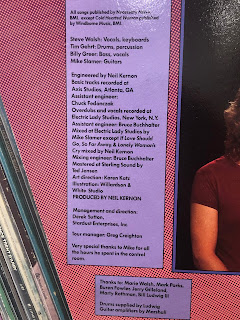
Streets - Credits
I wasn't disappointed - okay, I was disappointed that I hadn't found this when it came out. I know it would have spent a lot of time on my turntable. Is it really that good? Man, that's a hard call to make as I really enjoy it, and Steve Walsh was still in fine voice and seemed to relish working in a band structure. Just about half the songs on the album were written with the band, which is pretty cool. The album's closer "Fire" is pure '80s rock. Yeah, back when I said Steve had shed his Kansas baggage - I take it back. This song was awesome with all the pomp and grandeur you'd want with Steve's voice soaring and snarling like a man with something to prove.
 
This was still just hard rock, and the heady days of what would devolve (evolve?) into the hair band era was still a few years out. So when I hear this now, I have some trouble weeding out the noise and everything that came after that makes this sound more generic than it really was.
 
So, back to my initial question, is it good?
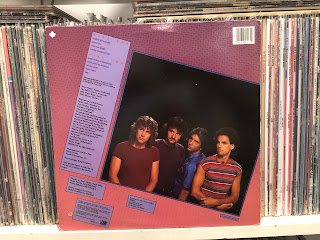
Streets - Back Cover
Yes, it's good. Really good - but too much time had elapsed by the time I got this, so I play it and enjoy it - a lot. Sadly, rather than sink into my musical DNA like other albums from that time, when I listen now it's mixed with equal parts admiration and nostalgia. I've played it many times over the years, and a few times now as I reacquainted myself with the songs writing this little blurb, but it'll only ever be a good album I found.
 
Shortly after the band's second album, Streets would come to a dead end and Steve and Billy would join a revamped Kansas.
 
Now, for shits and giggles, I made a playlist alternating the songs from Drastic Measures and 1st, and boy howdy, what would have been a hell of a double album.

Comments

Popular posts from this blog

Styx - Paradise Theater

Styx was hands down one of my favourite bands as a kid. They were a strange band, even back then. They were a hard rock band, almost progressive at times, who had a penchant for sucky ballads. I know there's a tendency for people to zero in on "Babe" as the song that killed the band's credibility. The roots go way back to almost the beginning when Styx released "Lady" on their second album. It showed a side to the band that needed to be kept in check, and for the most part the band kept things on a pretty tight leash. The band had been setting a gruelling pace, releasing an album a year (two in 1972) and by the time they released Paradise Theater (if I end up writing theatre later it's because that's how we spell it here) in 1981 they'd dropped ten albums in less than a decade. I snapped this up as soon as I saw it, and it became a fixture on my turntable. Like the band had announced on "Borrowed Time" from 1979's Cornerstone , ...

David Baerwald - Bedtime Stories

The little sticker on the shrinkwrap says, "You may remember David Baerwald from David & David's Boomtown ..." You bet, I remembered David Baerwald. Back in 1986 Boomtown was an album with moments of sheer brilliance. The whole album may not have been as top shelf as the first few tracks, but that didn't matter - it is an excellent album. I waited for a follow-up ... and waited, and then in 1990 it was a solo David, David Baerwald,  who dropped Bedtime Stories . I snapped it up. "All For You," the opening cut, is still my favourite song on the album. It was mesmerizing. I'm not sure if the song got any airplay, it may have, but that may have been wishful thinking on my part as it was on a lot of mix tapes at the time and I heard it a lot in the car. The CD had a great booklet with all of the musician credits and lyrics. Oddly, when I found a sealed copy of the record (a great score), it just had a plain paper insert - the picture of David walking wit...

Gary Numan - The Pleasure Principle

"Cars" was really the only song I knew by Gary Numan. I knew the name of the album the song came from. Over the years bits and pieces of trivia are accumulated, but in terms of his music it was still distilled down to one song ... It would be too easy to write Mr. Numan off as a one hit wonder, and I suppose in terms of actual chart hits this was his defining moment as a solo artist. Of course this really means nothing, as Gary Numan would drop an album a year pretty much through to the end of the '80s. He'd then slow down a little but continued to make music. While The Pleasure Principle was Gary Numan's debut solo release in '79, he actually cut his teeth on a couple of albums in a band called Tubeway Army, first with the band's self-titled release in 1978, and then on Replicas that came out in April of '79. By the end of Tubeway Army's run most of the band would follow Gary into his solo career. Paul Gardiner, who had been with Gary from the b...