For number four it's a mixed bag of five albums for your reading pleasure. Three out of five were new to me, which is always an adventure. I think my favourite find in the bunch this time around was the Joe Walsh release. I do love me some Joe Walsh.
Gotta say, four months in and I'm holding steady. It's the last Sunday in May, so without further ado...
Five for Fighting No.4
- Joe South - Games People Play (1970?)
- Moon Joyce - The Infinite Edge (1985)
- Wang Chung - Points on the Curve (1983)
- Joe Walsh - The Smoker You Drink, The Player You Get (1973)
- Nestor Pistor - Nestor Pistor for Prime Minister (1978)

Joe South - Games People Play (1970?) I was intrigued by the cover and figured this could be an interesting discovery, and at worst I'd be out a buck. This was a reissue on Pickwick, which meant it was licensed from Capitol and the songs were cobbled together from different releases. Not quite a greatest hits album, but a mixed bag of pretty interesting tunes. Trying to peg the release year is a bit of a shit show, as they don't print anything on the album or cover. I'm going to guess this was around 1970. Like all the Pickwick/33 releases, the album is short - nine songs that probably clock in at just over 30 minutes.
The production is very '60s, with a lot of thick reverb, and there's always more treble than bass. It made so many recordings sound thin and anemic. There are some wicked psychedelic moments too, as the feedback and echo on "Mirror of Your Mind" are pretty out there, and the electric sitar shows up on a couple of songs, one of which is "Games People Play."
I was surprised I recognized the title track, "Games People Play," which apparently took home two Grammy Awards in 1970, one of them Song of the Year. His version of "Rose Garden" is a little faster than the country lament Lynn Anderson sang when I was a kid. Joe South was a decent songwriter as well as a competent sideman, playing on Bob Dylan's Blonde on Blonde and a couple of Simon & Garfunkel albums in 1966, one of which was Sounds of Silence. A pretty cool score for a buck.
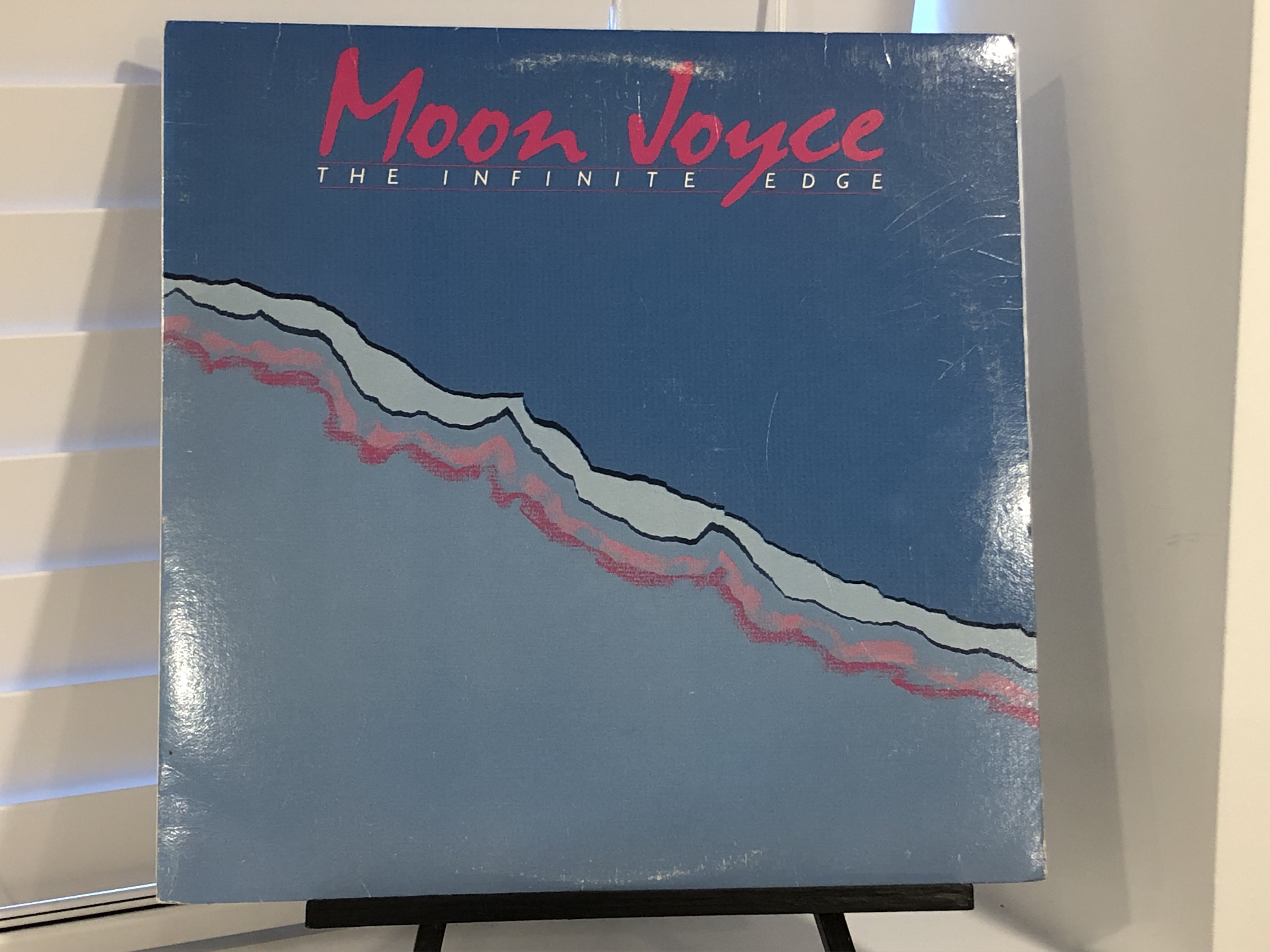
Moon Joyce - The Infinite Edge (1985) An unusual album for me, as I came in completely cold, not knowing anything about Moon Joyce. When I dropped the needle, the first track, "The Infinite Edge," had an '80s pop feel to it with a folk edge, and I thought, "Hey, this might be pretty good." Moon's voice, though, took me a bit to get used to. My initial thought was pretty uncharitable. "She sounds like a Sunday School teacher." Now, to be fair, she had a decent range, but she sounded like a folk singer who was used to singing around a campfire.
However, even though I only paid a buck, this was obviously an independent release and more than likely self-financed. I have a soft spot for indie artists. So rather than make pithy comments about why this would never be a hit, I listened and looked for the positive elements that make indie music so much fun to discover. To that end, there's actually a lot to enjoy here - and while this will not make a lot of appearances on my turntable, it was a decent effort. This is actually a really good-sounding recording. So many indie projects are cobbled together and sound like shit. This was crisp, full, and the performances are all enjoyable. I was happy to find that the lyric sheet mentioned on the back cover was actually enclosed. I also liked how she gave the dates and locations where the songs were written.
Let's give a shout-out to the musicians. Dan Donahue apparently was the kitchen sink here, playing guitar, programming the LinnDrum, and playing keyboards. Brian Scott handled bass, and Peter Allen played keyboards. Since there was an accordion player (spelled accordian on the jacket), that needs a mention too. Thank you, Dave Roman.

Wang Chung - Points on the Curve (1983) When Points on the Curve came out, the band seemed to be on the radio all the time with "Dance Hall Days." I'll admit it was catchy, and I liked it. I'd see the album in the store and think, "I should get this." Then I'd walk by. Then again, I did the same thing when Talking Heads were crushing it with "Burning Down the House." I would find reasons not to get the album. I remember seeing Talking Heads on SNL way back, and I found David Byrne to be pretentiously irritating, and that coloured everything the band did - for a long time. Of course, for both bands I'd eventually make up for lost time, but back in 1983 they just didn't make the cut. Ah, the self-righteousness of youth, and the unassailable belief that a verdict once rendered was set in stone.
This is still an album that never clicked with me the way To Live and Die in L.A. did. For a long, long time I considered it to be a near-perfect pop album. It's dated now, but the title track is still a song that'll stop me in my tracks. The first time I listened to Points on the Curve in its entirety was at my friend Tony's place in Ketchikan, Alaska, and the one song that really got me in the feels was "Don't Let Go." I added it to a mixtape I made there. It wasn't until now that I've actually played the album again. I don't want to reaffirm my early verdict, but aside from three great songs - which is a lot when you think about it - "Dance Hall Days," "Wait" (which would also show up on the To Live and Die in L.A. soundtrack), and "Don't Let Go," the album is made up of serviceable '80s synth-pop with a moody edge. Even now, though, it doesn't really make me wish I'd gotten it earlier. Also, what was with the weird abrupt ending to "Talk It Out"? It's jarring.

Joe Walsh - The Smoker You Drink, The Player You Get (1973) Boy, oh boy, this was a hell of a score for a buck. From what I can tell, this is an original 1973 ABC/Dunhill pressing. This was apparently supposed to be the second Barnstorm album, but ABC prominently displayed Joe Walsh's name front and centre, which more or less ended Barnstorm as a band. By the time So What came out in 1974, it was simply credited to Joe Walsh.
The gatefold is in pretty decent shape, and the vinyl, aside from a couple of clicks, is in far better shape than I'd even hoped. This is the album with "Rocky Mountain Way," and that right there is a dollar well spent. There was a brief period when I preferred Triumph's version... but now it's Joe all the way. The other highlight is "Meadows," even if the opening riff always calls to mind Deep Purple's "Woman from Tokyo." The rest of the song is so good. Dang, the rest of the album is really solid, and Joe Walsh was crafting his own sound back in the early '70s. I still have to check the date whenever I listen to "Rocky Mountain Way," because that just doesn't feel like 1973 to me. Then again, I'm trying to look back and imagine ten-year-old me trying to categorize music. It was either good, or it wasn't. This was good.

Nestor Pistor - Nestor Pistor for Prime Minister (1978) I've managed to find a few Nestor Pistor albums over the last few months in the dollar bin. I figured I'd start here, as it was nominated for Comedy Album of the Year at the Junos in 1979. He actually had two albums in the category that year; the other was a best-of anthology. He lost to Royal Canadian Air Farce.
When I was a kid, Nestor Pistor was forbidden fruit, right up there with MacLean & MacLean. All I knew was his albums had prominent "Adults Only" stickers, so they must have been pretty raunchy. Nestor Pistor for Prime Minister plays as light political commentary, and I have to admit the Trudeau references were pretty interesting, mainly because we still have a Trudeau as Prime Minister. The rest, aside from some amusing references to the left and right - which has always been a thing - was pretty dated. Unless you remember Ed Broadbent and some of the other political players of the day, you're kind of out of luck. While humorous in places, it wasn't especially biting or funny.
Too bad.
Comments
Post a Comment