Funny how things have changed. As a kid I hated Chicago. I mean, I remember hearing "Does Anybody Really Know What Time It Is?" and I would think, "Yeah, it's time to turn off the radio." Then, when David Foster unleashed "Hard to Say I'm Sorry" in the early '80s, Chicago would release a series of insufferable ballads that resulted in Peter Cetera becoming bigger than the band. I have to admit I secretly liked some of those songs. I eventually bought my first Chicago album in 1988 when the band released
17 - because I liked "Heart in Pieces" - I even liked it when Tim Feehan put out his version of the song on his 1990 release
Full Contact.
Yeah, I'm taking a while to get to the point, mainly because this is a weird album for me. I'm trying to process what I'm hearing. I found this for a buck, which means I paid fifty cents a side for this double album. Released in 1974
VII is a bit of an odd duck. Is it a jazz record? Is it a pop album? Is it rock? Now, admittedly I don't have a lot of knowledge about the band. I don't even have a greatest hits or anything to lean on. However, there's the radio, and the accumulation of nearly fifty years of tidbits about the band I have absorbed. I can also unequivocally say that Terry Kath, the band's late guitar player, was an astonishingly good player, and that Peter Cetera was a great bass player - and the horn arrangements were pretty spectacular. In short, Chicago was a band that shouldn't have worked on so many levels, but then again Steely Dan shouldn't have worked either - but for whatever reason rock audiences gave them a pass, and a key to the city.
I'm partway through the first side and the second song "Aire" is on, and I stopped typing so I could just hear Terry lay down his solo.
VII was jazz fusion and most of the first side is instrumental. There are the signature horn runs and a fair bit of flute. I don't think a track by track breakdown is going to be happening this time. I'm just going to sit back and take the advice of the narrator from The Tubes
Completion Backward Principle and just try and take this all in at a single sitting.
For a band that in later years would become synonymous to many with being an overtly commercial band, they certainly took their time on this one. Heck, the first album is almost completely instrumental, with the last two tracks on side two finally introducing vocals. The quirky "Life Saver" and then "Happy Man" closes out the first album.
Well, I may need to revise my earlier shot about the insufferable ballads as it would appear that with VII Peter Cetera was already pushing the band into more straight ahead pop with his one-two punch of "Happy Man" and "Wishing You Were Here" - then again, to be fair, "(I've Been) Searchin' So Long," written by trombone player James Pankow and sung by Peter Cetera, is a wonderful song and it too is a ballad. So while I seem to be taking mean spirited shots at Mr. Cetera's expense, I'll be honest here and say that when he was good he was really good and me taking pissy shots is just me protesting too much to try and maintain my rock credibility. I don't hear this and think 1974, I hear this and think, "Man, this was 1974?" It still sounds great.
Just when you think you can put a box around the band, they then go back off into their fusion form and unleash a mostly instrumental "Mongonucleosis" that feels almost like an extended game show theme. These guys were really the shit ... in a good way.
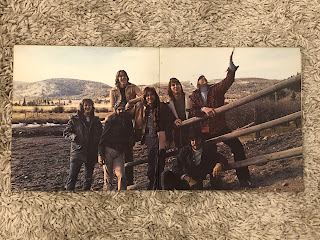
I have to say I'm still a bit perplexed as I try to juggle my childhood opinion and what I'm hearing fresh for the first time. I don't think Chicago will ever be one of those bands I list off on my fingers when I rattle off my favourites, but I definitely have a newfound respect for them. I wouldn't hesitate to pick up any other treasures should they present themselves.
The classic line-up:
- Danny Seraphine – drums
- Peter Cetera – bass, lead vocals
- Robert Lamm – keyboards
- Terry Kath – guitars, lead vocals, backing vocals
- Walter Parazaider – saxophones, flute
- Lee Loughnane – trumpet, lead vocals, backing vocals
- James Pankow – trombone, brass arrangements


Comments
Post a Comment