
Rough Trade - Avoid Freud

Rough Trade
Avoid Freud was released in the fall of 1980, but it wasn't until the following spring that "High School Confidential" seemed to be playing everywhere. We'd giggle when Carole sang, "It makes me cream my jeans when she comes my way." On the radio it would be bleeped, but it didn't matter. Most of us, or at least me, had no idea that it was a lesbian love song. It didn't matter - the song was infectious. There was of course the inevitable backlash when something becomes too popular.

For me, there was always something about Carole Pope's voice that was nails on a blackboard. I will admit that I liked "High School Confidential" right up until I didn't ... but with time I like it again. I had never heard anything other than what I heard on the radio. I had no desire to pick up an album, and when the Payolas released "Never Said I Loved You" in 1983 with Carole singing the duet with Paul, I would have a visceral reaction to the song when it came on the radio. I couldn't change the station fast enough. Time hasn't softened that one ... yet.

I'd never seen anything by Rough Trade in the dollar bin, which saved me from having to make a decision about whether or not to pass or play. Well, my luck ran out and there, along with some other albums I'd long dreaded finding, was Avoid Freud. It was time to face my fears.

I played it through a couple of times, and it was surprising. In a good way. This was very good, and honestly Carole killed it. The swagger and confidence she exudes on the tracks is almost tangible. She owns this ... although the closing track "Grade B Movie" is a perplexing steaming pile of musical crap. I suppose it was meant to be a piece of art ... it's a piece of something alright. Thankfully it's the last track as I'm generally too lazy to get up and lift the needle, so I just let it play through. Who knows, maybe it'll wear me down.
supporting cast
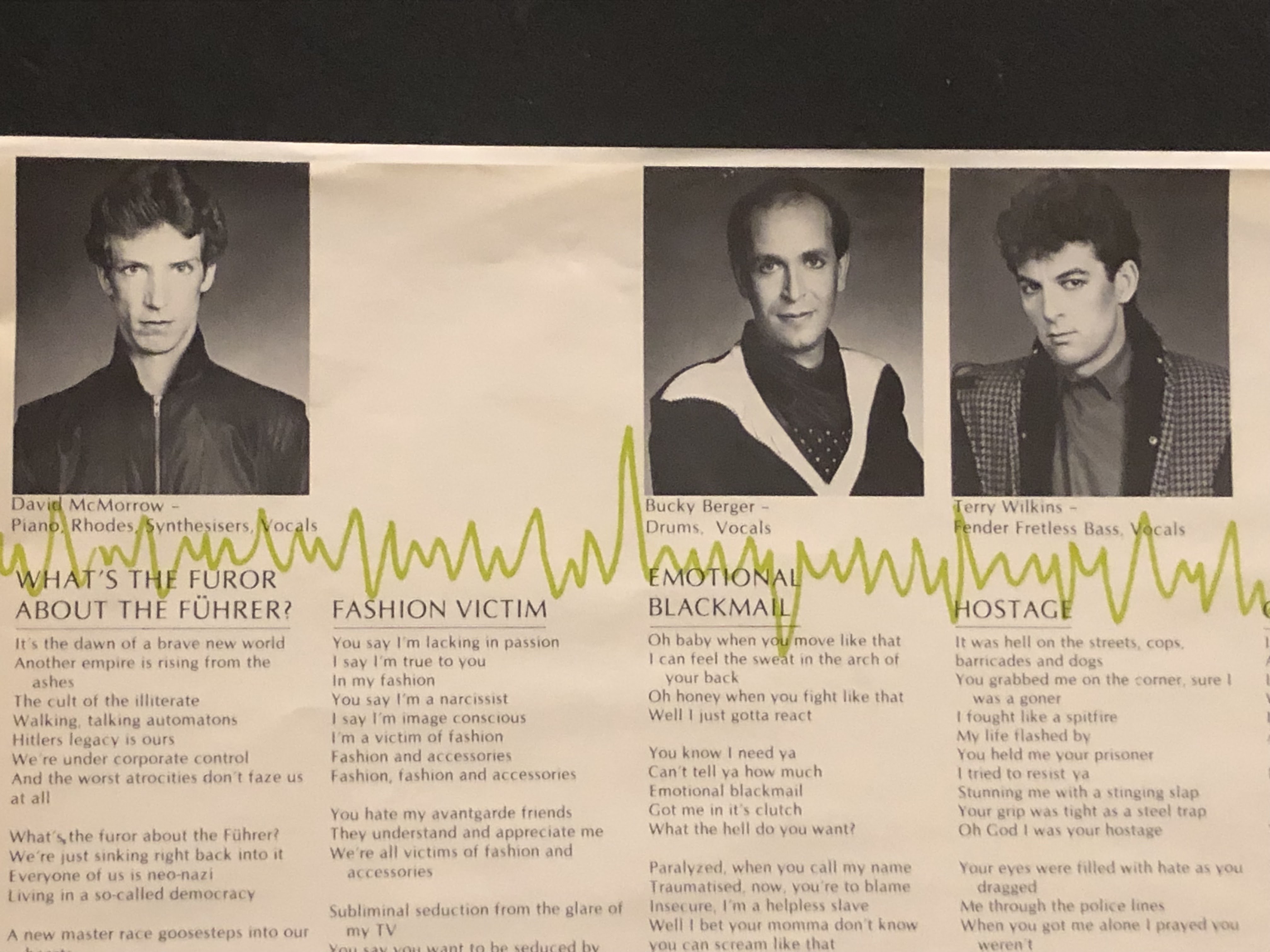
Rough Trade was centred on multi-instrumentalist Kevan Staples, who played guitar, piano and synth and sang backing vocals, and lead singer Carole Pope. They wrote the songs - it was their band. Rounding out the players here were David Morrow, who played keyboards, Bucky Berger on drums, and Terry Wilkins on fretless bass.

It's weird to think this came out in 1980 as so much of this sounds fresh and crisp still. Sure it was mining the skinny tie new wave, but the songs are thick and meaty - if that makes sense. Much of this can be attributed to the instrumentation and the wise choice to be as organic as possible while still incorporating technology. With Carole being so front and centre in the mix, everything you hear supports the songs. Doesn't hurt that it was mastered by one of the masters, George Marino.

I have to admit I really enjoyed nine of the ten songs here. Lyrically there's a lot to unpack and it's sad to think that while so much has changed, things are very much the same. "What's the Furor About the Fuher?" speaks to today as much as it did forty years ago - that makes me sad.

Back cover

However, I also wonder how much of a sense of humour Kevan and Carole had, as when I listened to "It's a Jungle" I kept thinking about John Wayne's 1962 classic (I loved it as a kid) Hatari! Red Buttons would call John Bwana ... I suspect I'm the only one making that comparison.

Regardless, now that I've popped my cherry, so to speak, with Avoid Freud, I won't be afraid to pick up more of the band's back catalogue should the occasion arise.

Too bad I've run out of space, I was going to tell you more about my mother. 


Comments

Popular posts from this blog

Styx - Paradise Theater

Styx was hands down one of my favourite bands as a kid. They were a strange band, even back then. They were a hard rock band, almost progressive at times, who had a penchant for sucky ballads. I know there's a tendency for people to zero in on "Babe" as the song that killed the band's credibility. The roots go way back to almost the beginning when Styx released "Lady" on their second album. It showed a side to the band that needed to be kept in check, and for the most part the band kept things on a pretty tight leash. The band had been setting a gruelling pace, releasing an album a year (two in 1972) and by the time they released Paradise Theater (if I end up writing theatre later it's because that's how we spell it here) in 1981 they'd dropped ten albums in less than a decade. I snapped this up as soon as I saw it, and it became a fixture on my turntable. Like the band had announced on "Borrowed Time" from 1979's Cornerstone , ...

David Baerwald - Bedtime Stories

The little sticker on the shrinkwrap says, "You may remember David Baerwald from David & David's Boomtown ..." You bet, I remembered David Baerwald. Back in 1986 Boomtown was an album with moments of sheer brilliance. The whole album may not have been as top shelf as the first few tracks, but that didn't matter - it is an excellent album. I waited for a follow-up ... and waited, and then in 1990 it was a solo David, David Baerwald,  who dropped Bedtime Stories . I snapped it up. "All For You," the opening cut, is still my favourite song on the album. It was mesmerizing. I'm not sure if the song got any airplay, it may have, but that may have been wishful thinking on my part as it was on a lot of mix tapes at the time and I heard it a lot in the car. The CD had a great booklet with all of the musician credits and lyrics. Oddly, when I found a sealed copy of the record (a great score), it just had a plain paper insert - the picture of David walking wit...

Gary Numan - The Pleasure Principle

"Cars" was really the only song I knew by Gary Numan. I knew the name of the album the song came from. Over the years bits and pieces of trivia are accumulated, but in terms of his music it was still distilled down to one song ... It would be too easy to write Mr. Numan off as a one hit wonder, and I suppose in terms of actual chart hits this was his defining moment as a solo artist. Of course this really means nothing, as Gary Numan would drop an album a year pretty much through to the end of the '80s. He'd then slow down a little but continued to make music. While The Pleasure Principle was Gary Numan's debut solo release in '79, he actually cut his teeth on a couple of albums in a band called Tubeway Army, first with the band's self-titled release in 1978, and then on Replicas that came out in April of '79. By the end of Tubeway Army's run most of the band would follow Gary into his solo career. Paul Gardiner, who had been with Gary from the b...