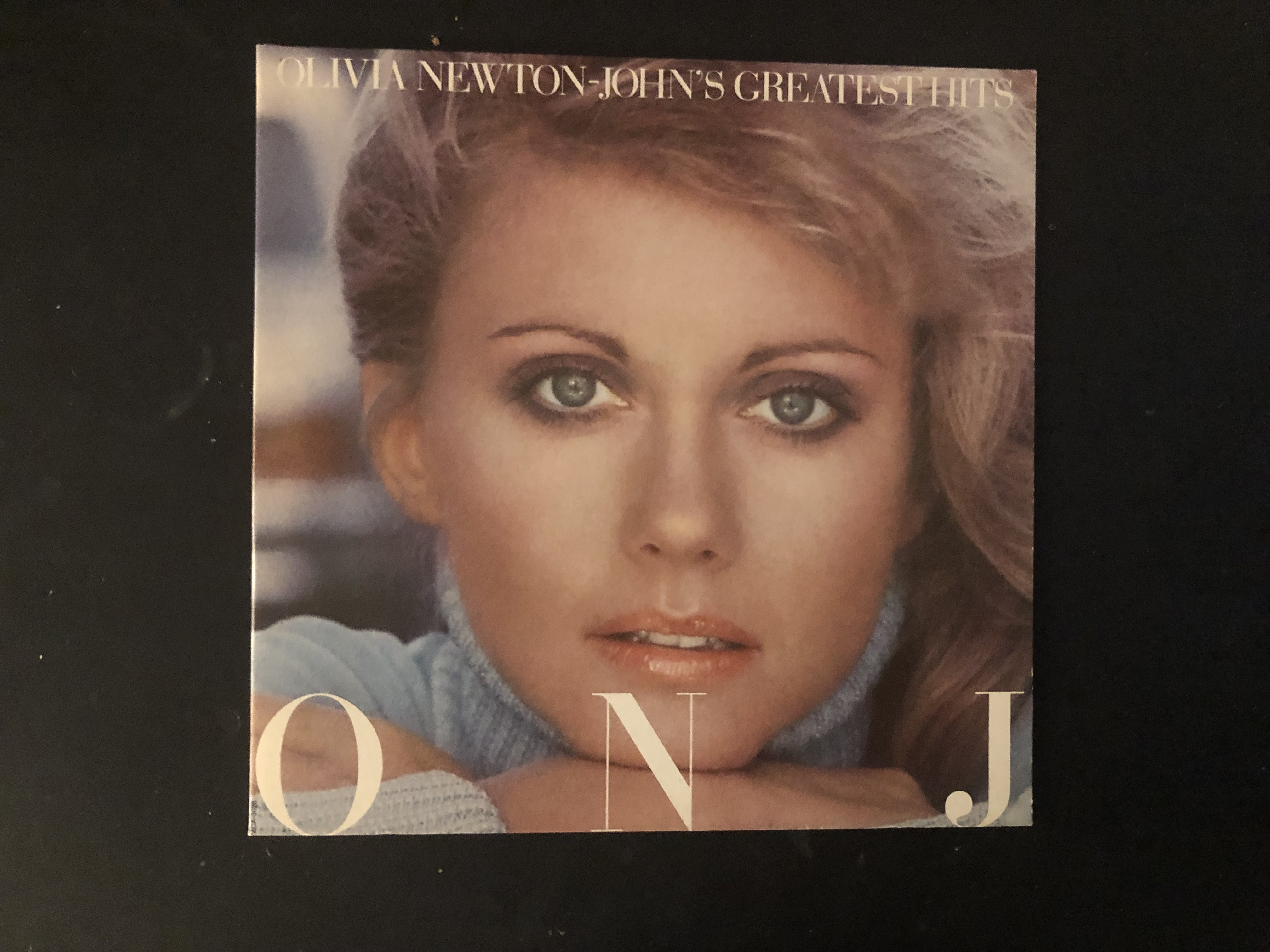
Olivia Newton John - Greatest Hits

Olivia Newton-John

As a kid, there was something pretty special about Olivia Newton-John. Ten year old me would sing along to the radio, belting out the chorus to "Let Me Be There," and all was right in the world. There were others too, and it was weird that this country singer was such a big deal to me. Of course, when I saw her album covers, she was so pretty. Maybe not Barbara Feldon pretty, but she was Agent 99. Yeah, that's a little embarrassing to think about now, but hey, it is what it is. It was also Agent 99 who once asked, "Do you ever think before you speak?" To which I should reply, "... would you believe ..."

Anyways, this was all before things changed when Grease was released. I loved early Olivia, but the later stuff was at odds with where I was musically. Oh, make no mistake, there was something wicked about "Evil" Sandy, the temptress in her black pants, but the music ... it was, it was, unthinkably horrid. HORRID. Of course, time has softened my opinion on the movie and the soundtrack, but at the time ... This was the forbidden period, and the disco stuff, and then the workout videos were too much.

However, this era, this early chapter before things went south, was magic. Now, with all this gushing gooeyness, you'd think I had her poster on my wall and a stack of records next to my bed. Nah, I have to admit that all I knew were the few radio hits. I never bought an album by her, but some of the big songs were pretty special. That's what the radio was for.

gatefold
The Greatest Hits touches on the big moments, "Let Me Be There" and "I Honestly Love You" along with "Please Mr. Please," a song that always got me in the feels. The schmaltz just didn't end there ... "Have You Ever Been Mellow" was pure syrup, and it was so good. These songs are so steeped in nostalgia that it's a weird feeling sitting here listening to the album. I mean, really, some of the arrangements and instrumentation are so cheesy it's almost awkward to listen to without cringing a little. Olivia's voice was so pure and earnest that it didn't matter. Of course, not every song was a familiar one, and those ones didn't really have a lot of impact, which is sort of what I expected.

The songs on the album are presented in chronological order, which is something I always like in an anthology. I know song order could be tweaked for presentation, but hearing the songs in the order they were released allows you to sort of experience the songs in roughly the order they were originally first heard. The songs were produced by John Farrar, who was behind all of her early albums and would work with her through many of her later releases as well.

back cover
It's still pretty impressive. She was still a young lady, not quite 30, and if she'd never released anything else after 1977, she still would have had one hell of a career. It's weird to think that her early country/pop era from the early to mid-'70s would be more or less a nostalgic footnote compared to her later career.

For me, though, I am partial to the first side. If they'd been able to squeeze "Please Mr. Please" onto Side One, I'd never turn the album over to look at the backside ... and why wouldn't I want to do that?

Friggin' Evil Sandy. 

Comments

Popular posts from this blog

Styx - Paradise Theater

Styx was hands down one of my favourite bands as a kid. They were a strange band, even back then. They were a hard rock band, almost progressive at times, who had a penchant for sucky ballads. I know there's a tendency for people to zero in on "Babe" as the song that killed the band's credibility. The roots go way back to almost the beginning when Styx released "Lady" on their second album. It showed a side to the band that needed to be kept in check, and for the most part the band kept things on a pretty tight leash. The band had been setting a gruelling pace, releasing an album a year (two in 1972) and by the time they released Paradise Theater (if I end up writing theatre later it's because that's how we spell it here) in 1981 they'd dropped ten albums in less than a decade. I snapped this up as soon as I saw it, and it became a fixture on my turntable. Like the band had announced on "Borrowed Time" from 1979's Cornerstone , ...

David Baerwald - Bedtime Stories

The little sticker on the shrinkwrap says, "You may remember David Baerwald from David & David's Boomtown ..." You bet, I remembered David Baerwald. Back in 1986 Boomtown was an album with moments of sheer brilliance. The whole album may not have been as top shelf as the first few tracks, but that didn't matter - it is an excellent album. I waited for a follow-up ... and waited, and then in 1990 it was a solo David, David Baerwald,  who dropped Bedtime Stories . I snapped it up. "All For You," the opening cut, is still my favourite song on the album. It was mesmerizing. I'm not sure if the song got any airplay, it may have, but that may have been wishful thinking on my part as it was on a lot of mix tapes at the time and I heard it a lot in the car. The CD had a great booklet with all of the musician credits and lyrics. Oddly, when I found a sealed copy of the record (a great score), it just had a plain paper insert - the picture of David walking wit...

Gary Numan - The Pleasure Principle

"Cars" was really the only song I knew by Gary Numan. I knew the name of the album the song came from. Over the years bits and pieces of trivia are accumulated, but in terms of his music it was still distilled down to one song ... It would be too easy to write Mr. Numan off as a one hit wonder, and I suppose in terms of actual chart hits this was his defining moment as a solo artist. Of course this really means nothing, as Gary Numan would drop an album a year pretty much through to the end of the '80s. He'd then slow down a little but continued to make music. While The Pleasure Principle was Gary Numan's debut solo release in '79, he actually cut his teeth on a couple of albums in a band called Tubeway Army, first with the band's self-titled release in 1978, and then on Replicas that came out in April of '79. By the end of Tubeway Army's run most of the band would follow Gary into his solo career. Paul Gardiner, who had been with Gary from the b...